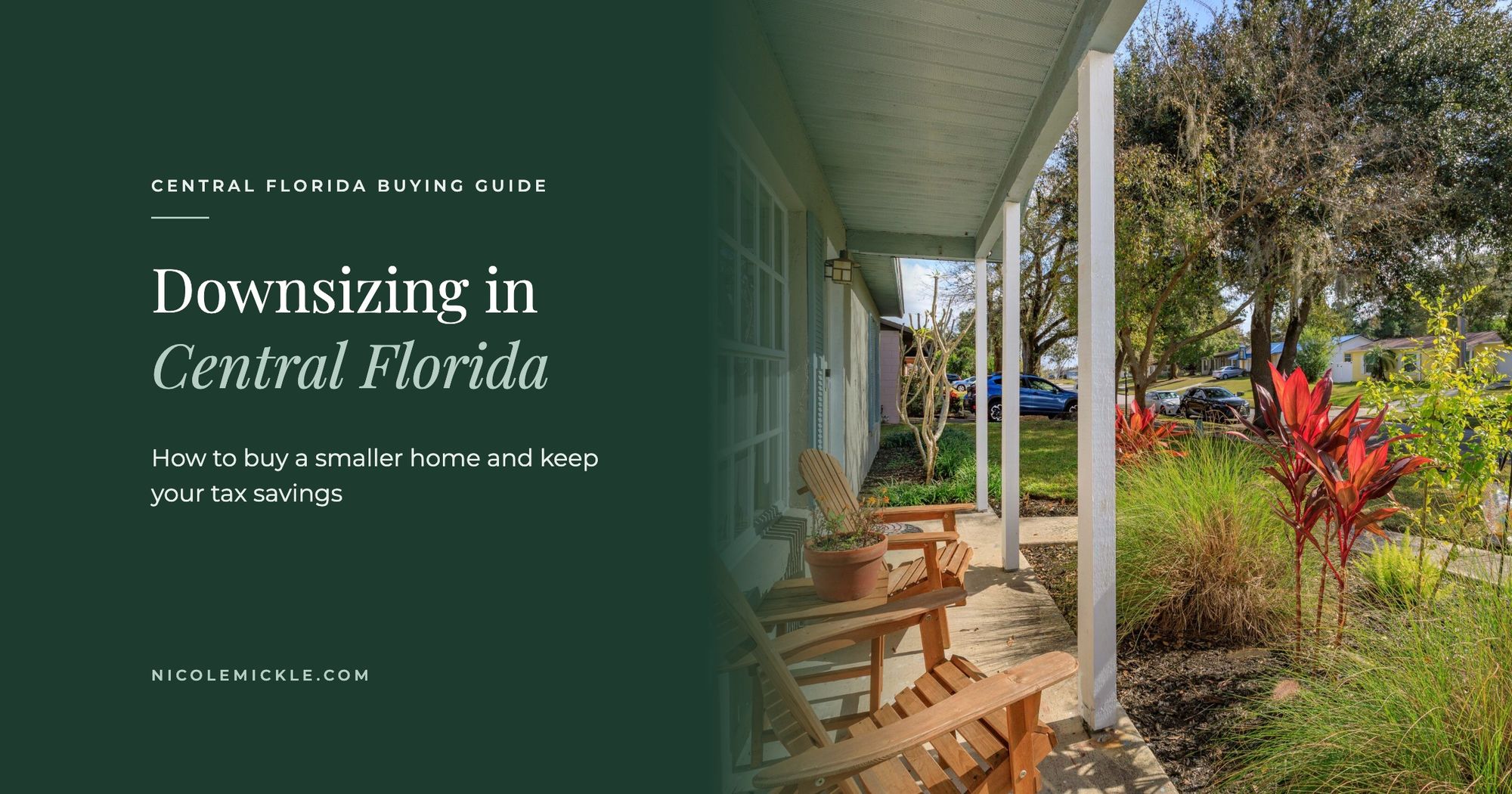
Downsizing in Central Florida: How to Buy a Smaller Home
How to downsize in Central Florida: choosing a smaller home, keeping your homestead tax savings, timing the sale and purchase, and planning for HOA and CDD fees.

Nicole Mickle
Realtor, Olympus Executive Realty
TL;DR
- Smaller doesn't have to mean less: many Central Florida buyers downsize into single-story new construction, villas, or townhomes with less upkeep and newer systems.
- Keep your tax savings: Florida homestead portability lets you move up to $500,000 of your Save Our Homes benefit to your next homestead if you qualify within about three years.
- Plan the timing: decide early whether you'll sell first, buy first, or use a rent-back, because each one changes your risk and your cash needs.
- Run the full monthly cost: a smaller home can still carry HOA dues, a CDD assessment, and a higher insurance bill than you expect.
Downsizing is usually less about giving things up and more about choosing what you actually want from a home. For a lot of my clients, that means fewer rooms to maintain, a single-story plan, a lock-and-leave lifestyle, or freeing up equity for travel and other plans. I'm Nicole Mickle, a Central Florida relocation and new construction specialist. I ran a mobile closing company for 23 years and have been a licensed Realtor since 2012, so I've seen how the sale of one home and the purchase of the next come together at the closing table. Here's how to buy a smaller home in Central Florida without leaving money or time on the table.
What does downsizing look like in Central Florida?
Downsizing in Central Florida usually means trading a larger resale home for one that's easier to own: a single-story new build, a villa or paired home, a townhome, or a home on a smaller lot where the HOA handles some of the outdoor maintenance. Many buyers keep the same finish level or even step up in quality while reducing square footage, upkeep, and the number of rooms they heat, cool, clean, and insure.
How do you decide what you need in your next home?
Start with how you use your current home, not how big it is. Walk through it and note which rooms you use every week and which ones mostly hold furniture and storage. That list tells you what to keep in the next home and what you can let go.
- Must-haves: the number of bedrooms and bathrooms you'll actually use, a primary suite on the main floor, an office, or a garage with room for storage or a golf cart.
- Nice-to-haves: a flex room for guests or hobbies, a covered lanai, or a pool you won't have to maintain yourself.
- Long-term livability: features like a step-free entry, wider doorways, and a walk-in shower are easier to choose now, especially on new construction, than to retrofit later.
If you're weighing floor plans, my comparison of one-level homes vs. two-story homes covers cost, layout, and resale.
Why do so many downsizers choose new construction?
New construction lets you get the size and layout you want without paying for space you won't use. Builders across Central Florida offer single-story plans in a range of sizes, and you can often choose finishes and structural options during design selections. A new home also comes with a new roof, new systems, and a builder warranty, which can make insurance and maintenance more predictable in the first years.
The trade-off is time. Depending on the builder and the stage of construction, a to-be-built home can take several months to finish, which can work in your favor if you need time to sell. My guides to purchasing a new construction home and semi-custom homes walk through the process, and you can browse new construction communities in Central Florida.
What happens to your property taxes when you downsize in Florida?
If your current home has a Florida homestead exemption, you may be able to take part of your tax savings with you. Florida's Save Our Homes cap limits how much a homestead's assessed value can rise each year, and portability lets you transfer up to $500,000 of that accumulated difference to a new homestead. You must qualify for homestead on the new home by January 1 of the third year after you gave up the old one, and you file the transfer application (Form DR-501T) with your new homestead application by March 1 (Lake County Property Appraiser).
When you downsize, the benefit is calculated in proportion to the new home's value: the new home's market value is divided by the old home's market value, then multiplied by the old home's assessed value. Your county property appraiser can estimate the number before you buy. On new construction, also plan for the first-year bill that may cover only the land. My post on property taxes on new construction explains why.
Do you owe tax on the gain when you sell your current home?
Many homeowners don't. If you owned and lived in the home as your main residence for at least two of the last five years, you may be able to exclude up to $250,000 of gain, or up to $500,000 if you're married filing jointly (IRS Topic 701). If you've owned your home for a long time or used part of it as a rental or office, talk with a CPA before you list. I'm not a tax advisor, and the details depend on your situation.
Should you buy first or sell first when you downsize?
It depends on how much cash you can access before your current home sells and how comfortable you are carrying two homes for a while. Here are the four approaches I see most often.
| Approach | How it works | Watch out for |
|---|---|---|
| Sell first | Close on your current home, then buy with the proceeds. | You may need temporary housing or a rent-back. |
| Buy with a home sale contingency | Your purchase depends on your current home selling by a set date. | Sellers and builders may not accept it in a competitive market. |
| Buy first with a bridge loan or equity line | Borrow against your current home's equity to fund the next down payment. | You may carry two payments until your home sells. |
| Sell with a rent-back | Close the sale, then lease your old home back for a short, agreed period. | Terms, deposits, and insurance must be in the contract. |
Talk with your lender about which options fit your finances.
From the closing side, a rent-back works best when it's spelled out in the contract: how many days you'll stay, what you'll pay, who insures what, and how much is held back at closing to cover damage. If you're buying new construction, ask the builder early whether it will accept a home sale contingency, since policies vary by builder and by community.
How do HOA and CDD fees change the math?
A smaller home doesn't always mean a smaller monthly payment. Many newer Central Florida communities have HOA dues that cover amenities and sometimes lawn care, and some also carry a community development district (CDD) assessment that appears on your property tax bill. Ask for both before you write an offer. My guide to HOA and CDD fees explains what to ask, and you can run the full payment with the mortgage calculator.
How do you declutter for a smaller floor plan?
Declutter to the new floor plan, not to a vague goal. Once you know which home you're buying, get the room dimensions from the listing or the builder's plan and decide what furniture will actually fit.
- Measure first: map your largest pieces against the new rooms before you move them.
- Sort in four groups: keep, sell, donate, and discard. Work one room or one closet at a time.
- Digitize paper and photos: scanning documents and photo albums frees up a surprising amount of storage.
- Start before you list: a lighter, decluttered home also shows better to buyers. My post on selling your Orlando home covers how I prepare a home for market.
How do you choose the right location?
Think about how you want to spend your days. Make a list of what you want nearby, such as your doctors, a grocery store, parks and trails, golf, restaurants, or the airport, and how long you're willing to drive to each one. Visit at different times of day to check traffic and noise. My neighborhood quiz matches your priorities to Central Florida communities, and my overview of Orlando's communities covers the major areas.
Ready to plan your next move?
The best downsizing plans line up the sale, the purchase, and the move before you sign anything. Reach out to me, and we'll map out the timing, the numbers, and the homes that fit how you want to live.
Frequently Asked
Questions, answered
Can I transfer my homestead tax savings to a smaller home in Florida?
Often, yes. Florida homestead portability lets you transfer up to $500,000 of your Save Our Homes benefit to a new Florida homestead. When the new home is worth less, the benefit is reduced in proportion. You must qualify for homestead on the new home by January 1 of the third year after leaving the old one and file Form DR-501T with your county property appraiser.
Should I buy or sell first when downsizing?
It depends on your cash and your comfort with carrying two homes. Selling first removes the risk of two payments but may require temporary housing or a rent-back. Buying first is easier with a bridge loan, an equity line, or a home sale contingency the seller or builder will accept.
Do I pay capital gains tax when I sell my home to downsize?
Many sellers don't. If you owned and lived in the home as your main residence for at least two of the last five years, you may be able to exclude up to $250,000 of gain, or $500,000 if married filing jointly. Check your situation with a CPA.
Is new construction a good choice for downsizing?
It can be. New construction lets you choose a single-story plan and the size you want, and it comes with new systems and a builder warranty. The trade-off is the build time, which can work well if you need several months to sell your current home.