Your Real Estate Business Plan Shouldn't Start With a Sales Number
Most real estate business plans start with a sales number and work backward into more calls. Here's how to build one that starts with your life, then fits the business around it.

Nicole Mickle
Realtor, Olympus Executive Realty
Most real estate business plans start the same way. Pick a big sales goal, divide it by your average price, and work backward into how many calls, appointments, and contracts you need. The math is clean. The life it creates often isn't.
I build my plan the other way around. I start with the income I want, the hours I'm willing to work, and the clients I enjoy serving. Then I build the business to fit. After three decades in Central Florida real estate, that approach has given me a business I still love running.
How should a real estate agent build a business plan?
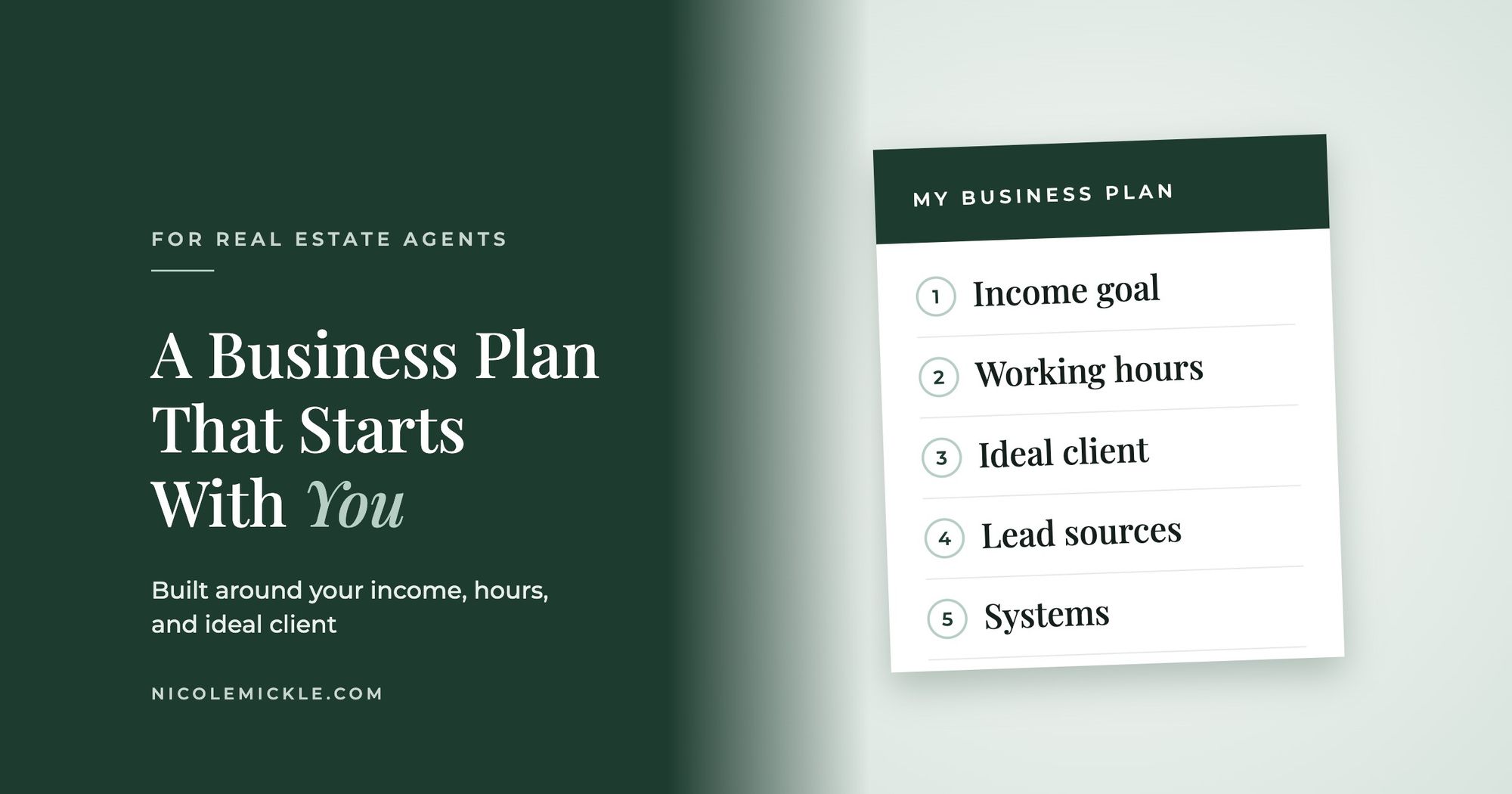
Start with your life, not a sales target. Decide your income goal, the hours you want to work, and the client you want to serve. Then choose a niche, the few lead sources that reach that client, and the systems that follow up for you. Your sales number becomes the result of the plan, not the starting point.
Why sales-first plans lead to burnout
A plan built only on a sales target has one answer to every problem: do more. Behind on your goal? Make more calls. Slow month? Add another lead source. Nothing in the plan protects your evenings, your weekends, or the kind of work you enjoy.
That's why so many one-size-fits-all coaching plans feel great in January and exhausting by June. The plan never asked what you wanted the business to feel like. I wrote more about this in why I don't chase volume.
The five steps of a life-first real estate business plan
1. Set your income goal
Write down what you need to earn, then what you'd like to earn. Be specific. This is your number, not a number someone else picked to sound impressive.
2. Decide your working hours
Choose the days and hours you'll work, and when you're off. Real estate will always have urgent moments, but most "urgent" requests can wait until morning when clients know your schedule.
3. Define your ideal client
Who do you enjoy working with, and who values what you know? My answer is relocation and new construction clients across Central Florida, people who want an advisor who understands the market and has relationships within it. If you're deciding how to position yourself, read real estate agent vs. real estate advisor.
4. Choose two or three lead sources
Pick the places your ideal client already looks: search, referrals, a specific social platform, a builder relationship. Two or three done well will outperform eight done halfway. If you work with sellers, my guide on how to get more seller leads can help you choose.
5. Build the systems that follow up for you
A website that answers questions, an email sequence for new leads, a simple way to track clients, and a calendar that protects your time. These are what let the plan run without you running yourself down.
| Factor | Sales-first plan | Life-first plan |
|---|---|---|
| Starting point | A sales or transaction goal | Your income, hours, and ideal client |
| Main activity | More calls and more leads | A few lead sources and strong systems |
| When it's behind | Work more hours | Adjust the system or the niche |
| Who it fits | Agents who want high volume | Agents who want a sustainable business |
What most agents get wrong about business planning
They copy someone else's plan. A plan that works for a team running high volume will not work for a solo agent who wants to be home by six. Neither plan is wrong. They're just built for different lives.
The second mistake is never revisiting the plan. Look at it every quarter. Which lead source brought your best clients? Which system saved you the most time? Do more of that and drop what isn't working. [NICOLE: add one thing you changed in your own plan after reviewing it.]
Your next step
If social media is one of your lead sources, make every post count. My free swipe file has 30 first lines and 10 fill-in-the-blank captions you can use this week, each one built to send people somewhere you own.
Frequently Asked
Questions, answered
What should be in a real estate agent business plan?
A real estate business plan should include your income goal, working hours, ideal client, niche, two or three lead sources, the systems you'll use to follow up, a marketing calendar, and a budget. Review it every quarter and adjust based on where your best clients actually came from.
How many transactions does a real estate agent need a year?
It depends on your income goal, your average price point, and your commission split. Agents serving higher price points or a focused niche can often reach their goal with fewer transactions. Work from your own numbers instead of an industry average.
Can I build a real estate business working normal hours?
Yes, with clear expectations and good systems. Tell clients when you're available, use email and your website to answer common questions, and protect your off hours. Most clients respect a schedule they know about from the start.